

By applying a scientist’s eye to the classroom, Maria Montessori changed the landscape of modern education. Her methods and teachings have since impacted several generations across the world.
Who is Maria Montessori?
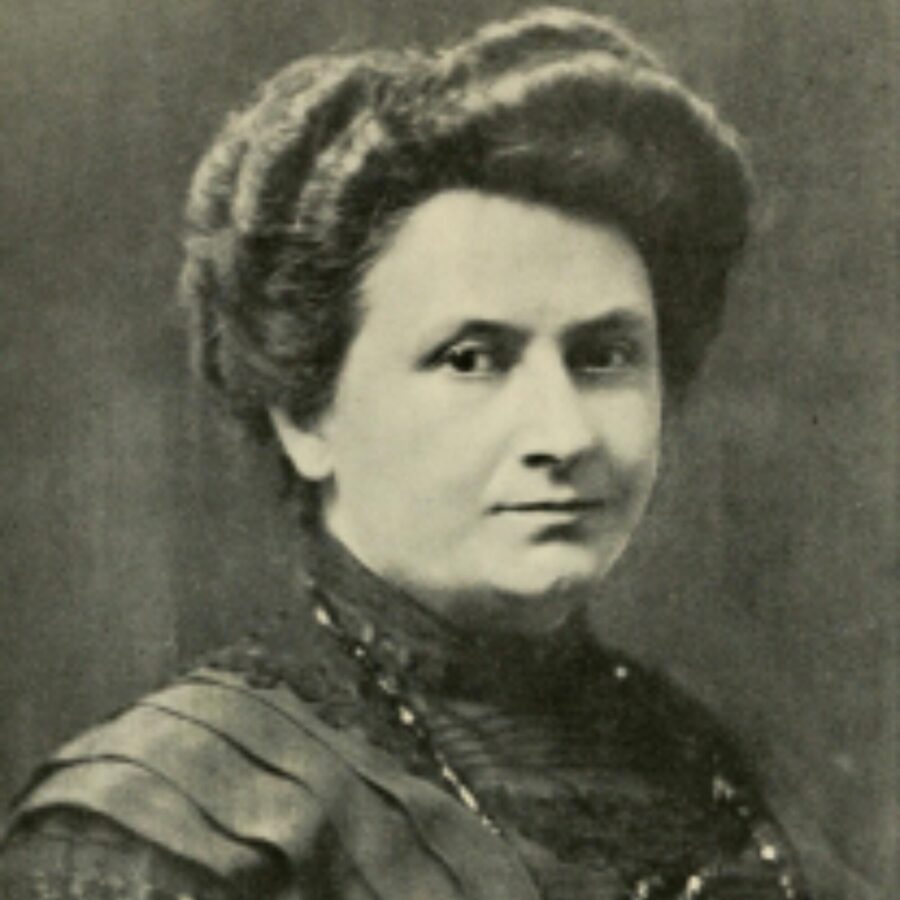
Maria Montessori was an Italian physician and founder of the Montessori education system. As one of the first female doctors in Italy, she challenged gender stereotypes, advocating throughout her life for the “New Woman” vision in which she demanded equal pay and opportunities for men and women.
Her Childhood and Early Career
Maria Montessori was born in 1870 to Alessandro Montessori and Renilde Stoppani in Chiaravalle, Italy. Her father was an Italian soldier who later worked as a civil servant for the Vatican and her mother was a well educated woman for the time who encouraged her to continue with her education although her father disagreed, aligning with the traditional gender roles assigned by society,
When Maria Montessori graduated secondary school in 1886, at the age of sixteen, she understood that she had a specific love for mathematics and the sciences. Therefore, she decided to study engineering at the Regio Istituto Tecnico Leonardo da Vinci (Royal Technical Institute Leonardo da Vinci) for her higher secondary school education.
Montessori, having finished her time at the engineering institute in 1890 as one of the very few girls studying there, went down an even more unusual path, considering cultural norms at the time, and decided to study medicine. In July 1896, she became one of the first female doctors in Italy.
The Barriers Maria Montessori Faced
Between the years 1890 and 1892, Maria Montessori faced constant rejection from the Faculty of Medicine in the University of Rome because of her gender. During these years she earned a degree in Natural Sciences. With the help of Pope Leo XIII, the University of Rome was pressured to accept her as a medical student.
In 1893, Montessori enrolled in the University of Rome but rather than acceptance, she was met with hostility from her male teachers and peers alike. Due to the sexist values of the university, dissections were not permitted to be carried through in mixed classes, so she had to perform them alone.
Montessori represented Italy at the 1896 International Congress for Women’s Rights hosted in Berlin. During the conferences she was asked by a reporter how patients would react to being treated by a woman and she said “they know intuitively when someone really cares about them[.…] It is only the upper classes that have a prejudice against women leading a useful existence”.
Despite her rising scientific profile, Montessori’s reputation was threatened when she gave birth to her son Mario Montessori in 1898 from her relationship with the doctor Giuseppe Montesano, whom she met during the research project at the University of Rome. Due to the fact that she was unmarried when she gave birth and Montesano was unwilling to have any involvement in the upbringing of their son if Maria Montessori continued with her career in science, she understood that if she raised the child herself, her career would be at risk. The idea of a child born out of wedlock was a scandalous image which would completely damage her reputation. Therefore she made the decision to give her son over to the care of a farmer’s family in the Italian countryside. She made it known to society that he was her nephew so that she wouldn’t have the stigma of being an unmarried mother attached to her name. During the next few years however, Montessori would ensure that she would often visit her son, maintaining a strong relationship throughout his childhood.
Her Work in Education
In November 1896, Maria began to work in the Santo Spirito Hospital in Rome as a surgical assistant, where she specifically worked for the poor and children. The next year she joined a research programme at the psychiatry clinic of the University of Rome.
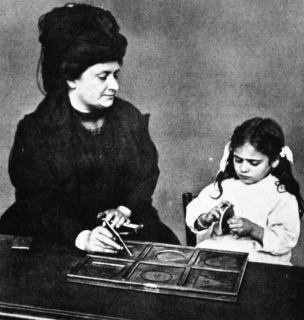
In 1907, Maria Montessori opened the first Casa dei Bambini (Children’s House) in a low-income district in Rome. It was here that she began to promote the idea of hands-on learning. The main educational resource Montessori began to use was her design of sandpaper letters and numbers. The idea of the use of sandpaper was the sound it created when children traced the paper and the children were able to copy the sound, hence allowing them to retain the memory of writing and pronunciation before they knew how to read.
In 1939, Maria Montessori and her son, Mario, were invited by the theosophical Society to go to India for a three month training course. The Theosophical Society promoted literacy in India and fostered the strong belief that there is a fundamental unity between all forms of life. Montessori had already received the support and recognition from some of the most prominent freedom fighters and educators of India such as Mahatma Gandhi and Rabindranath Tagore through their mutual understanding that independence in a classroom is a more effective method of learning. During those three months in Madras (now Chennai) she gave the first Indian Montessori Course and students were said to have admired her work ethic and principles in transforming how education was viewed.
India had been ruled over by the British Empire from 1757 to 1947, however during the Second World War, under Winston Churchill’s leadership, the political climate shifted drastically. Montessori’s Italian origins were seen as a threat in 1939 because of the political tension that was occurring at that time. Despite the fact that Britain viewed both Maria and Mario Montessori as ‘enemy aliens’ she was allowed to remain in India to continue her contributions towards education until the end of World War II in 1946. During these years, she trained hundreds of teachers through establishing the Montessori Method and led many more training courses through her time in exile. Inspired by the teachings of the Theosophical Society, Montessori developed her Cosmic Education framework that she would later introduce to the western world. This framework introduced the philosophy that every child should be able to understand the complexities of the universe through the idea that humanity has a responsibility to protect and appreciate their environment.
Having returned from India, Montessori led the 1946 London lectures, the first of many training courses she would give in post-war Europe. These lectures drew from her empirical observations of the different educations she had seen the children across the world receive over decades of travel. In this course she was quoted: “Adults move because their will directs them, but not so with the small child. The small child is urged by nature.”
Her Legacy
Maria Montessori died in 1952 from a cerebral haemorrhage in the Netherlands while discussing her plans to travel to Africa with her son. Currently, the Montessori Education system has been adapted to over 500 state-funded public schools across the world. Her philosophy is that young children must be able to fully immerse themselves in the learning, through touch and their senses before they hold the information in their minds. Maria Montessori’s dedication towards studying the philosophy and biology behind learning has altered previous concepts of what education was meant to be.
This article was written by Elika Dutta, connect with Elika on LinkedIn here.